
Most profitable businesses assume their marketing is working.
After all, revenue is coming in. The business is running. Growth exists.
But look closer.
Marketing still feels unclear.
Messaging feels inconsistent.
And visibility doesn’t match the strength of the business.
This is where many growing companies get it wrong.
Profit does not mean your marketing strategy is strong.
It often means your operations are.
The reality is simple.
Many profitable businesses are growing despite their marketing, not because of it.
And without a clear, structured marketing strategy, that growth eventually slows, stalls, or becomes difficult to scale.
This is why even strong businesses continue to struggle with marketing.
Not because they lack effort —
but because they lack direction.
The Common Assumption — “If the Business Is Profitable, Marketing Is Working”
This is one of the most common—and costly—assumptions in growing businesses.
Revenue creates confidence.
It gives the impression that everything is working as it should.
But revenue is not proof of strong marketing.
In many cases, it’s proof of strong operations.
A business can grow because of:
- referrals
- repeat customers
- existing reputation
- strong product or service delivery
None of these guarantee that marketing is doing its job.
Marketing is not just about generating sales.
It is about creating clarity, positioning, and scalable demand.
When marketing is weak, it shows in different ways:
- inconsistent messaging across channels
- lack of clear brand identity
- dependence on referrals instead of predictable growth
- difficulty scaling beyond current levels
The business may be profitable.
But the marketing system behind it is not structured for growth.
This is where the gap begins.
A strong business can exist with weak marketing—but it cannot scale without fixing it.
Why Marketing Still Fails in Growing Businesses?
As businesses grow, marketing activity usually increases—but performance does not always follow.
More campaigns.
More channels.
More spend.
Yet growth still feels inconsistent.
The issue is not effort.
It is lack of structure.
Without a clear marketing strategy for growing businesses, marketing becomes fragmented, reactive, and difficult to scale.
👉Lack of Clear Marketing Strategy
Many growing businesses operate without a defined marketing direction.
Decisions are driven by:
- short-term needs
- trends
- external suggestions
This creates reactive marketing.
Campaigns change frequently.
Priorities shift without clarity.
There is activity, but no long-term direction.
Without a clear strategy, marketing cannot deliver consistent results.
👉Fragmented Execution Across Channels
As businesses grow, they often work with:
- an SEO agency
- a social media team
- paid ads specialists
Each focusing on their own area.
But without alignment:
- messaging becomes inconsistent
- channels operate in isolation
- performance becomes difficult to measure
Execution happens—but not in one direction.
👉Weak Brand Positioning
Many businesses struggle to clearly communicate:
- what they do
- who they are for
- why they are different
This leads to:
- generic messaging
- low differentiation
- reduced perceived value
Without strong positioning, marketing loses impact—no matter how much is invested.
👉No Central Marketing Leadership
In many cases, no one is fully responsible for marketing outcomes.
Decisions are:
- spread across teams
- influenced by multiple vendors
- made without a single strategic authority
This results in:
- lack of accountability
- inconsistent direction
- slow decision-making
When no one leads marketing, no one truly owns the results.
‘Marketing does not fail because of lack of tools or channels. It fails because it lacks structure, clarity, and leadership.’
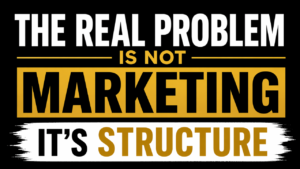
The Real Problem Is Not Marketing — It’s Structure
Most businesses believe their marketing is underperforming because something is wrong with their execution. They look at SEO, ads, or content and assume one of these needs fixing. But the reality is different. SEO is not the problem. Ads are not the problem. Content is not the problem. These are simply tools, and tools only work when they are used within a clear system.
The real issue is the lack of structure. Without a defined strategy, aligned messaging, and controlled execution, marketing becomes scattered. Different channels operate in isolation, decisions are made reactively, and results become inconsistent. There may be effort, there may be activity, but there is no clear direction guiding it.
Strong marketing is not built by doing more. It is built by creating a system where every action is aligned, every decision is intentional, and every channel works toward a single objective. Without that structure, even the best marketing efforts fail to deliver sustainable growth.
"The businesses that win long-term are not the ones that do the most marketing. They are the ones with the most structured marketing."
What a Strong Marketing Strategy Looks Like?
A strong marketing strategy is not built on more activity.
It is built on clarity, alignment, and control.
It ensures every part of your marketing works in one direction—toward growth.
A structured marketing strategy for growing businesses includes:
Clear positioning — A defined market position that explains who you are, who you serve, and why you are different. This creates clarity in how your brand is perceived.
Unified messaging — Consistent communication across all channels, so your audience receives one clear and strong message, not mixed signals.
Aligned channels — SEO, social media, paid ads, and content all working together under one strategy, rather than operating independently.
Controlled budget allocation — Marketing investment is directed intentionally, focusing on what drives results instead of being spread across disconnected efforts.
Measurable outcomes — Clear performance tracking that shows what is working, what is not, and where to optimise for growth.
Without these elements, marketing remains reactive and inconsistent.
With them, marketing becomes structured, predictable, and scalable.
How to Fix Marketing in a Growing Business
Fixing fragmented marketing is not about doing more.
It is about correcting the structure.
Before changing campaigns, channels, or tactics, the foundation must be fixed.
✅ Step 1 — Define Your Positioning
Everything starts with clarity.
What does your business stand for?
Who are you trying to reach?
Why should they choose you over every alternative?
Without clear positioning, every marketing effort becomes inconsistent.
Document it. Make it the foundation of every decision.
✅ Step 2 — Audit Your Current Channels
Look at everything currently active:
website
social media
paid ads
SEO
content
Then ask:
Is the message consistent?
Is every channel working toward the same goal?
Most businesses discover gaps here.
Messaging breaks. Direction shifts. Effort is wasted.
✅ Step 3 — Align All Execution
Execution must follow one strategy.
Every agency, freelancer, and internal team should operate from:
the same positioning
the same messaging
the same priorities
the same performance goals
Without alignment, even good execution produces weak results.
✅ Step 4 — Introduce Marketing Leadership
Someone must own the outcome.
Not just campaigns.
Not just channels.
The entire marketing system.
This could be:
an internal leader
a fractional CMO
a strategic marketing partner
The key is clear accountability.
When no one leads, no one is responsible.
✅ Step 5 — Remove Fragmentation
Too many decision points slow everything down.
Multiple vendors, multiple opinions, multiple directions.
Simplify.
Reduce fragmentation by consolidating control under one strategic authority.
The result:
faster decisions
consistent execution
stronger outcomes
When structure is fixed, marketing becomes clear, controlled, and scalable.
That is when growth becomes predictable—not accidental.
Why Execution Alone Is Not Enough
Execution is everywhere.
Every agency can run ads.
Every freelancer can post content.
Every vendor can promise results.
That’s not the problem.
The problem is thinking execution is enough.
Without direction, execution is just movement.
Without structure, it’s just noise.
You can run campaigns every week and still have no clear growth.
You can spend more and still stay invisible.
Because execution does not create growth.
Leadership does.
Until someone defines the strategy, controls the direction, and owns the outcome, marketing will remain inconsistent—no matter how much is done.
From Activity to Authority
Most businesses operate in activity mode.
More campaigns.
More channels.
More effort.
But growth doesn’t come from doing more.
It comes from doing the right things, in the right direction.
This is the shift:
From doing → leading
From scattered → structured
From disconnected execution → unified strategy
At Metanite, we don’t add more marketing.
We take control of it.
We define positioning.
We align execution.
We build a system where every action serves a clear objective.
That’s the difference between activity and authority.
Final Thoughts
Profitability does not mean your marketing is strong.
It often means your business is.
Without clear positioning and structured strategy, growth will always feel limited.
Because real growth is not built on effort.
It is built on clarity and control.
Positioning creates direction.
Structure creates consistency.
Together, they create growth.
Bring Clarity to Your Marketing
If your marketing feels busy but not structured, the issue is not what you’re doing.
It’s how it’s being led.
At Metanite Marketing, we bring clarity, direction, and control to your marketing—so your brand reflects the strength of your business.